Breastmilk collection and distribution at the Southern Philippines Medical Center Human Milk Bank from 2019 to 2021
SPMC J Health Care Serv. 2022;8(1):4 ARK: https://n2t.net/ark:/76951/jhcs7q2tf2
1Research Utilization and Publication Unit, Southern Philippines Medical Center, JP Laurel Ave, Davao City, Philippines
Correspondence Melivea I Melgazo, iridescentph@gmail.com
Received 22 January 2022
Accepted 4 March 2022
Cite as Melgazo MI, Ladrero CXD. Breastmilk collection and distribution at the Southern Philippines Medical Center Human Milk Bank from 2019 to 2021. SPMC J Health Care Serv. 2022;8(1):4. https://n2t.net/ark:/76951/jhcs7q2tf2
In accordance with Republic Act (RA) 10028, also known as the “Expanded Breastfeeding Promotion Act of 2009,”1 the Southern Philippines Medical Center (SPMC) established the first human milk bank in Davao Region in 2018. As stipulated in the implementing rules and regulations of RA 10028, health institutions, such as SPMC, are encouraged to build milk banks for the proper donor screening, collection, storage, transport, processing, and distribution of human milk.2
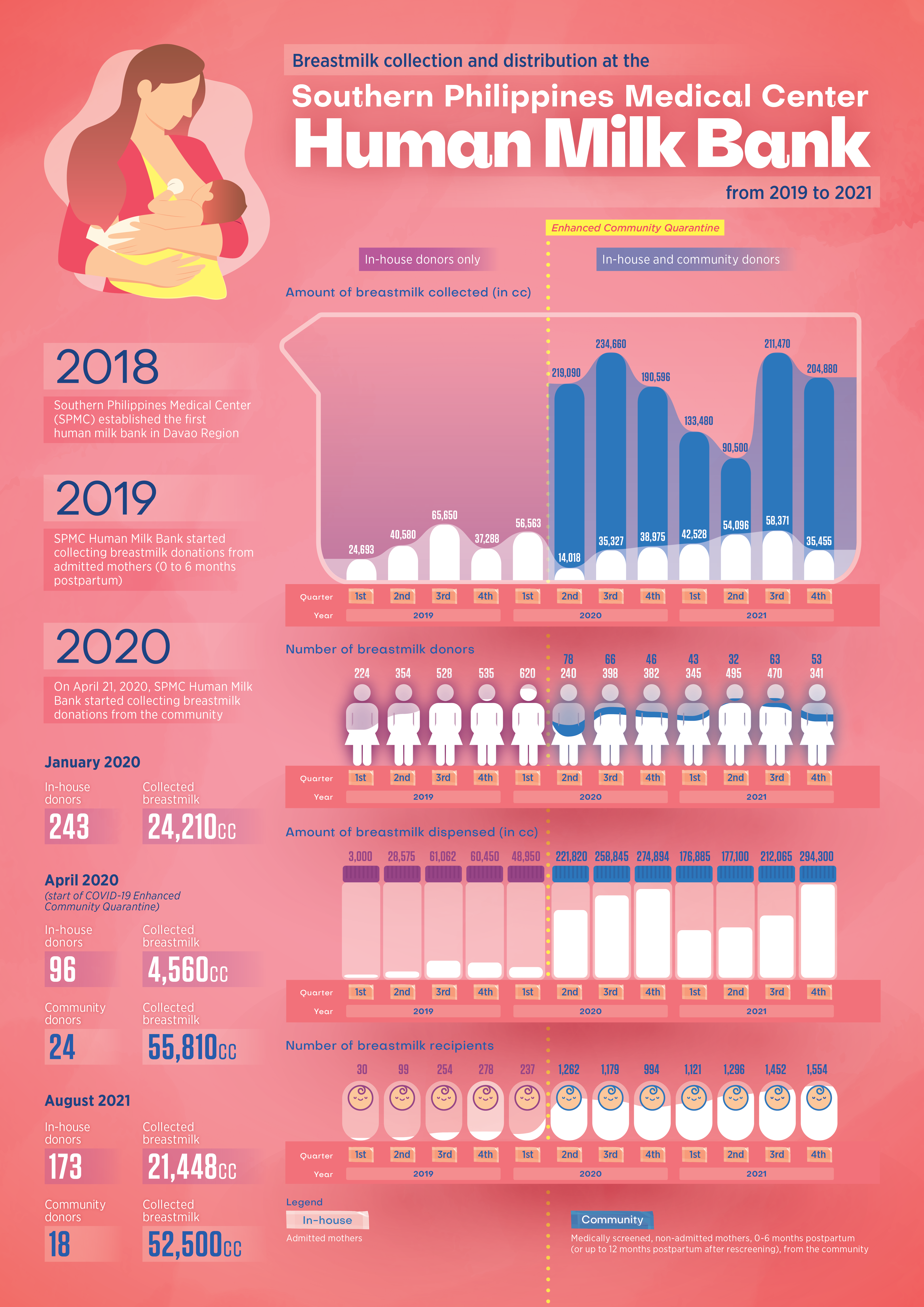
This infographic includes data on breastmilk collection by the SPMC Human Milk Bank (HMB) from January 2019 to December 2021. In January 2019, the SPMC HMB started collecting breastmilk donations from mothers within zero to six months postpartum during their hospital stay at the SPMC Institute for Women and Newborn Health (IWNH) facility. At present, the SPMC HMB exclusively supplies breastmilk to admitted neonates and other pediatric patients requiring isolation from their mothers. During the first year of milk collection, there was a steady increase in milk supply, which peaked in January 2020, when 243 donors supplied the milk bank with 24,210 cc of breastmilk.
The COVID-19 pandemic caused significant delays in the collection of in-house breastmilk donations due to limitations imposed during the enhanced community quarantine (ECQ), which started on April 4, 2020. In order to minimize the risk of COVID-19 infection among postpartum patients, the IWNH discharged most patients strictly within 72 hours from admission. This drastically dropped the breastmilk collection from in-house donors, and the daily collection could not replenish the minimum amount needed to supply the needs of recipient neonates and other pediatric patients. In April 2020, only 96 admitted mothers donated 4,560 cc of breastmilk to the milk bank. On April 21, 2020, the SPMC HMB, with the help of LATCH (Lactation, Attachment, Training, Counseling, Help)—a non-governmental organization empowering mothers through lactation education—and other breastfeeding advocates, started collecting breastmilk donations from mothers in the community after the donors complete and pass a screening process. Because of this, the milk bank was able to acquire an additional 55,810 cc of breastmilk from an additional 24 donors from the community in April 2020. At its peak, milk collection reached 73,948 cc of breastmilk from 191 donors, both from admitted mothers and from the community, in August 2021.
The importance of motivating lactating mothers to donate breastmilk and of actively seeking breastmilk contributions from the community cannot be overemphasized, since these ensure a continuous supply of breastmilk in the milk bank. While breastmilk allocation by the SPMC HMB is presently limited to sick neonates and infants admitted in the hospital, providing the needs of non-admitted well babies, whose mothers are unable to provide breastmilk adequately, is definitely consistent with the plan of the milk bank to expand its services in the near future.
Contributors
MIM and CXDL contributed to the conceptualization of this article. MIM wrote the original draft while CXDL rendered the original draft of the infographic. Both authors performed the subsequent revisions, approved the final version, and agreed to be accountable for all aspects of this article and its corresponding infographic.
Acknowledgments
We would like to thank Dr Melanie B Adolfo and Ms Nicky Jane Polinar Salas of the Southern Philippines Medical Center Human Milk Bank for providing the necessary data used in this article.
Article source
Commissioned
Peer review
Internal
Competing interests
None declared
Access and license
This is an Open Access article licensed under the Creative Commons Attribution-NonCommercial 4.0 International License, which allows others to share and adapt the work, provided that derivative works bear appropriate citation to this original work and are not used for commercial purposes. To view a copy of this license, visit https://creativecommons.org/licenses/by-nc/4.0/
References
1. Congress of the Philippines. An act expanding the promotion of breastfeeding, amending for the purpose Republic Act No. 7600, otherwise known as “an act providing incentives to all government and private health institutions with rooming-in and breastfeeding practices and for other purposes”, Republic Act No. 10028 (2010 March 16).
2. Department of Health. An act expanding the promotion of breastfeeding, amending for the purpose Republic Act No. 7600, otherwise known as “an act providing incentives to all government and private health institutions with rooming-in and breastfeeding practices and for other purposes”, The Implementing Rules and Regulation of Republic Act No. 10028 (2011 Aug 22).
Copyright © 2022 MI Melgazo, et al.

Published
April 27, 2022
Issue
Volume 8 Issue 1 (2022)
Section
Infographic

This work is licensed under a Creative Commons Attribution-NonCommercial 4.0 International License.
Authors who publish with this journal agree to the following terms:
- Authors retain copyright and grant the journal right of first publication with the work simultaneously licensed under a Creative Commons Attribution-NonCommercial 4.0 International License that allows others to share the work for non-commercial purposes with an acknowledgement of the work's authorship and initial publication in this journal.
- Authors are able to enter into separate, additional, non-commercial contractual arrangements for the non-exclusive distribution of the journal's published version of the work (e.g., post it to an institutional repository or publish it in a book), with an acknowledgement of its initial publication in this journal.
- Authors grant the journal permission to rewrite, edit, modify, store and/or publish the submission in any medium or format a version or abstract forming part thereof, all associated supplemental materials, and subsequent errata, if necessary, in a publicly available publication or database.
- Authors warrant that the submission is original with the authors and does not infringe or transfer any copyright or violate any other right of any third parties.