Health care financial support for patients needing medical assistance in Southern Philippines Medical Center: policy notes
SPMC J Health Care Serv. 2023;9(2):7 ARK: https://n2t.net/ark:/76951/jhcs344ukc
1Research Utilization and Publication Unit, Southern Philippines Medical Center, JP Laurel Ave, Davao City, Philippines
Correspondence Christine May Perandos-Astudillo, alleiandrah@gmail.com
Received 12 October 2023
Accepted 27 December 2023
Cite as Perandos-Astudillo CM, Roño RC. Health care financial support for patients needing medical assistance in Southern Philippines Medical Center: policy notes. SPMC J Health Care Serv. 2023;9(2):7. https://n2t.net/ark:/76951/jhcs344ukc
Introduction
Accessing health care services can lead to a significant financial burden on patients, especially when an episode of illness necessitates out-of-pocket (OOP) expenditures.1 Apart from health improvement, an essential function of health care systems is to provide financial protection for individuals against the costs associated with illness.2 The establishment of the Philippine Health Insurance Corporation (PhilHealth) has emerged as a crucial step towards achieving the goal of universal health care for individuals in need of medical services.3 Since the passage of the Universal Health Care Act in 2019, all Filipinos have been automatically enrolled in PhilHealth for social health risk protection. In 2021, PhilHealth covered health care utilization claims amounting to over Php 88 billion.4 PhilHealth coverage is usually not sufficient to fund the entire hospital expense in a single episode of illness. Meanwhile, the creation of other government health care financing schemes helps alleviate the financial burden of patients.
Through the enactment of the Republic Act (RA) 11463, also known as the Malasakit Centers Act, patients may now seek financial aid from a unified assistance hub to settle outstanding health care expenses not covered by PhilHealth. The Malasakit Centers Act mandates the establishment of one-stop shops for medical and financial assistance. This one-stop shop consists of representatives from the Department of Health (DOH), PhilHealth, the Philippine Charity Sweepstakes Office (PCSO), and Department of Social Welfare and Development (DSWD).5
This article aims to recommend health care policies to improve the existing health financing mechanisms currently sought by patients to cover their medical expenses during an episode of illness.
Main evidence
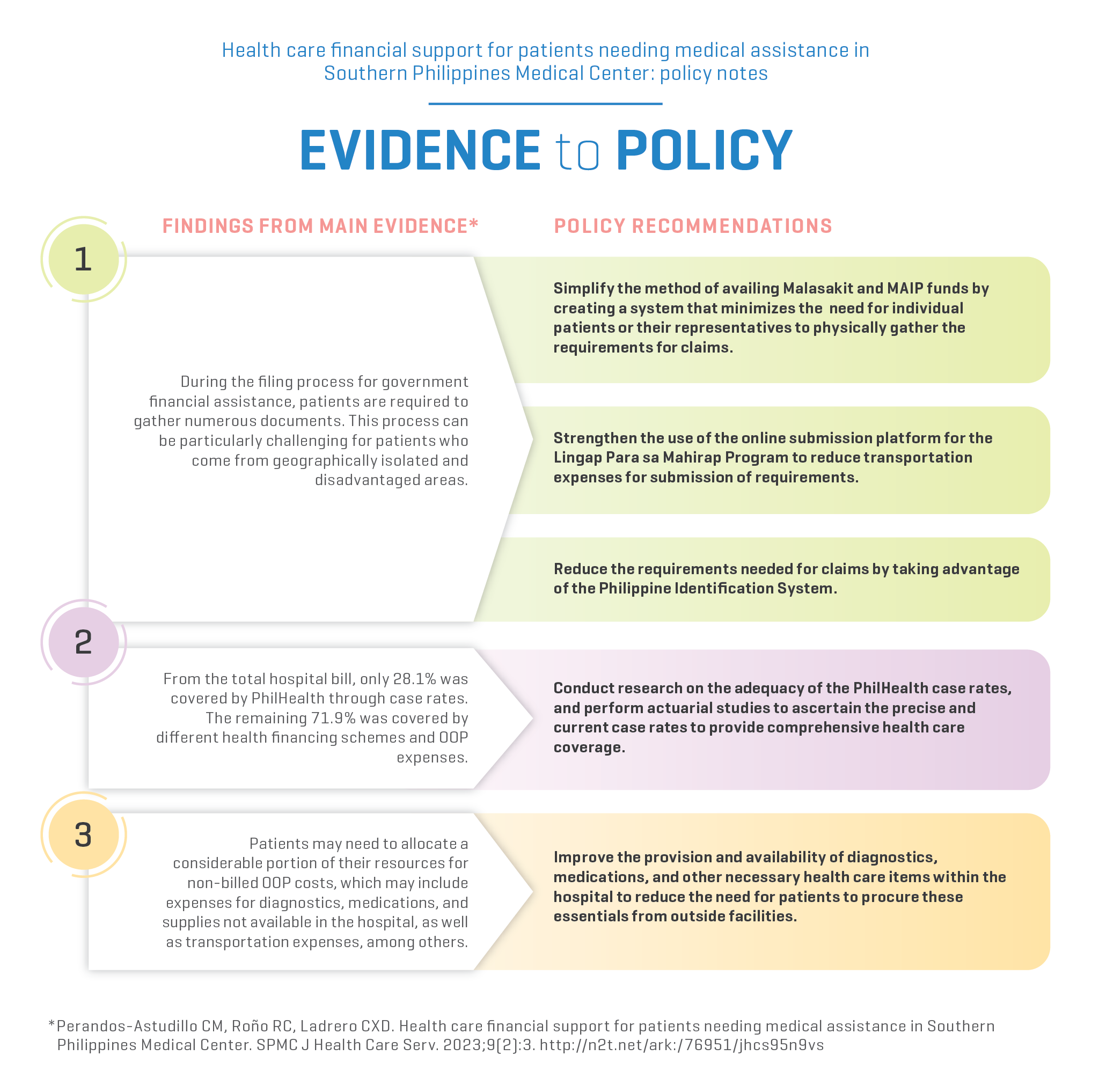
The characteristics of the health care financing schemes for patients needing medical assistance in Southern Philippines Medical Center (SPMC) have been described in an infographic article.6 In SPMC, patients, especially the indigent and financially incapacitated, may benefit from several government-initiated health financing schemes to help cover their hospital expenses. While SPMC houses several offices for various health financing schemes, the prerequisites to access these services can pose challenges for many patients. This is especially true for patients from geographically isolated and disadvantaged areas who often find fulfilling these requirements to be a daunting task.6 For example, to benefit from the Lingap para sa Mahirap Program, a patient must submit a computerized hospital bill, a medical certificate or certificate of confinement with the hospital logo, and a barangay certification of voter's certificate.7 Gathering these documents may take a few days and would require a patient or their watcher to travel back to their barangay and then return to the hospital. PhilHealth only covered 28.1% from the total hospital bill for all patients admitted to SPMC from January 2022 to September 2023. The balance of 71% was covered by several discounts (4.7%) and different programs such as the Malasakit Center Program (3.9%), Medical Assistance to Indigent Patients (MAIP) Program (26.2%), and SPMC subsidy via quantified free services (QFS) (36.2%). The remaining 0.9% had to be covered by the patients' OOP expenses. In addition to covering the hospital bill, a patient must also spend on non-billed OOP expenses. These could include costs for diagnostics, medications, and other necessary health care items that are not available in the hospital, along with the added expense of transportation.6
Based on the data presented in the infographic article, we have outlined our policy recommendations in the following evidence-to-policy diagram.
Evidence-to-policy diagram
|
Related evidence
When patients have ready access to health care, they are at lower risk of poor health outcomes. They are more empowered to make informed decisions that affect their health. Consequently, the Philippines currently has government health financing schemes (e.g., the MAIP Program), in addition to social health insurance or compulsory contributory health care financing schemes, that provide enhanced and more comprehensive access to health care.
The MAIP Program, an initiative of the DOH, provides inpatient and outpatient financial assistance for essential and life-saving medicines, services, and other medical products as prescribed by a licensed physician or health personnel, beyond the coverage of the PhilHealth case rates/packages and/or other financing resources. Any Filipino citizen who demonstrates a clear inability to pay for one’s treatment is eligible to become a program beneficiary, as assessed by a medical social worker (MSW).8 9
When seeking assistance from government health financing sources, patients or their families must submit the necessary documents required by the MSW to assess their financial eligibility. This process involves traveling to and from their residence and preparing multiple copies of the same document for submission to various offices. This task can be particularly daunting for those living in geographically isolated and disadvantaged areas (GIDA), where additional funds are needed for transportation.
In order to expedite the process of applying for financial assistance, the MSW facilitates provision of medical assistance requests and ensures the delivery of necessary services.9 By simplifying the complex application process, streamlining in-person applications, and establishing an online application procedure that enables patients to answer screening questions and upload necessary documents, patients can gain an earlier and more accurate understanding of how much aid they are qualified to receive.10 11
Online platforms for requesting medical assistance, such as Lingap Para sa Mahirap, must be further promoted not only through social media but also through broadcast media, which people in GIDAs have more access to. In addition to this, local government units (LGU) open more satellite offices to cater to these areas.12 National databases, such as the Philippine Identification System (PIS), must be designed to include household incomes in order to identify financially incapacitated and indigent patients upfront. This should be readily accessible by government health financing sources, especially the DSWD. Consequently, this would make transactions more seamless since patients won’t have to prove their financial incapacity every time they are admitted to the same or another hospital, thus eliminating a relatively duplicative process.10 11 13
Another approach to create more accessible health care services is by reducing the requirements needed to file claims. Filling-out numerous forms is tedious and time-consuming. By decreasing the number of forms that need to be completed, patients would find it easier to comply with the required documents necessary to file their insurance and health care financing benefits.14 Additionally, patient data stored in the PIS could be utilized to enhance efficiency and accuracy in claims management. As a result, this would lead to lower operating costs and better customer experience.15
In a study conducted on actively paying self-earning PhilHealth members, the majority of the respondents claimed that they received only 10% to 40% coverage of their hospital bills from PhilHealth. Out-of-pocket expenditures ranged from Php 10,000 to Php 20,000.16 The current coverage of PhilHealth for patients' hospitalization is insufficient to cover the total, or at least a significant amount, of the hospital bill.17 18 19 20 The great disparity between the actual hospitalization cost and the PhilHealth’s case rate payment contributes to this insufficiency, resulting in low financial protection for its members. With this knowledge, policymakers and other stakeholders can devise strategies to increase the rate of PhilHealth’s benefit packages, leading to increased financial coverage for hospitalization and outpatient care for every Filipino.21 22
The unavailability of medications inside the hospital can impose a significant financial burden on patients. A survey conducted in the Philippines showed that availability of 50 sampled drugs was lower in public hospital/retail pharmacies (1.3% for originator brands, 25.0% for lowest-priced generics) compared to private hospital/retail pharmacies (34.7% for originator brands, 35.4% for lowest-priced generics). It was also found that the median unit price of medicines in private sectors was higher compared to those in public sectors.23 This implies that due to the unavailability of drugs within the hospital pharmacy, especially in public hospitals, patients would not only incur OOP expenses, but also potentially face higher costs for medications. Enhancing the availability of medicines, diagnostic procedures, and other vital health care items and services within the hospital can minimize the necessity for patients to obtain these essentials from external facilities, thereby providing financial protection to patients against excessive health care costs.
Leveraging government health care financing is imperative to improve access, affordability, and equity in health care. By streamlining the application and enrollment process in filing claims from government health financing schemes, expanding social health insurance coverage, and improving the affordability of drugs and other health services, patients can have a better health care experience, and consequently, better health outcomes.
Contributors
CMPA and RCR contributed to the conceptualization of this article. All authors wrote the original draft, performed the subsequent revisions, approved the final version, and agreed to be accountable for all aspects of this report.
Article source
Commissioned
Peer review
Internal
Competing interests
None declared
Access and license
This is an Open Access article licensed under the Creative Commons Attribution-NonCommercial 4.0 International License, which allows others to share and adapt the work, provided that derivative works bear appropriate citation to this original work and are not used for commercial purposes. To view a copy of this license, visit https://creativecommons.org/licenses/by-nc/4.0/.
References
1 Tobe M, Stickley A, del Rosario RB Jr, Shibuya K. Out-of-pocket medical expenses for inpatient care among beneficiaries of the National Health Insurance Program in the Philippines. Health Policy Plan. 2013 Aug;28(5):536-48.
2 Bredenkamp C, Buisman LR. Financial protection from health spending in the Philippines: policies and progress. Health Policy Plan. 2016 Sep;31(7):919-27.
3 Querri A, Ohkado A, Kawatsu L, Remonte MA, Medina A, Garfin AMC. The challenges of the Philippines' social health insurance programme in the era of Universal Health Coverage. Public Health Action. 2018 Dec 21;8(4):175-180.
4 Philippine Health Insurance Corporation. Malasakit at Pag-asa sa Panahon ng Pandemya Annual Report. 2022 [cited 2023 Dec 27]. Available from: https://www.philhealth.gov.ph/about_us/annual_report/AR2021.pdf
5 Congress of the Philippines. An Act Establishing Malasakit Centers in all Department of Health (DOH) Hospitals in the Country and in the Philippine General Hospital (PGH), Providing Funds Therefor and for Other Purposes, Republic Act No. 11463 (2019 Nov 18).
6 Perandos-Astudillo CM, Roño RC, Ladrero CXD. Health care financial support for patients needing medical assistance in Southern Philippines Medical Center. SPMC J Health Care Serv. 2023;9(2):3. https://n2t.net/ark:/76951/jhcs95n9vs
7 City Government of Davao. Lingap para sa Mahirap. [cited 2023 Dec 27]. Available from: https://lingap.davaocity.gov.ph/services/
8 Department of Social Welfare and Development. Guidelines on the availment of lingap at gabay para sa may sakit (LINGAP SA MAHIRAP), Memorandum Circular No. 07, Series of 2018 (2018 Apr 6).
9 Department of Health. Revised guidelines on the Implementation of the Medical Assistance to Indigent Patients (MAIP) Program, Administrative Order No. 2020-0060 (2020 Dec 23).
10 Hospital Referral Services. Financial Assistance Screening Application. [cited 2023 Dec 27]. In: Hospital Referral Services [Internet]. Cleveland: Hospital Referral Services. c2023. Available from: https://hospitalreferralservices.com/financial-assistance-screening-application/
11 Draeger J. 3 Ways to Simplify the Financial Aid Process. [cited 2023 Dec 27]. In: Education and Career News [Internet]. Stockholm: Mediaplanet Group. c2023. Available from: https://www.educationandcareernews.com/college-preparedness/3-ways-to-simplify-the-financial-aid-process/
12 Alama RI. Davao City LGU promotes online Lingap transactions. 2023 Jan 6 [cited 2023 Dec 27]. In: Philippine Information Agency [Internet]. Quezon: Philippine Information Agency. c2023. Available from: https://pia.gov.ph/news/2023/01/06/davao-city-lgu-promotes-online-lingap-transactions
13 Ambegaokar S, Neuberger Z, Rosendaum D. Opportunities to Streamline Enrollment Across Public Benefit Programs. 2017 Nov 2 [cited 2023 Dec 27]. In: Center on Budget and Policy Priorities [Internet]. Washington: Center on Budget and Policy Priorities. c2023. Available from: https://www.cbpp.org/research/food-assistance/opportunities-to-streamline-enrollment-across-public-benefit-programs
14 Government Service Insurance System. GSIS reduces paper requirements for claims. 2014 Apr 21 [cited 2023 Dec 27]. In: Government Service Insurance System [Internet]. Pasig: Government Service Insurance System. c2023. Available from: https://www.gsis.gov.ph/gsis-reduces-paper-requirements-for-claims/
15 Singhal S, Dash P, Schneider T, Chowdhary S, Aggarwal H. For better healthcare claims management, think “digital first’. 2019 Jun 14 [cited 2023 Dec 27]. In: McKinsey & Company [Internet]. Illinois: McKinsey & Company. c1996-2023. Available from: https://www.mckinsey.com/industries/healthcare/our-insights/for-better-healthcare-claims-management-think-digital-first
16 Philippine Health Insurance Corporation. Impact of immediate eligibility to the willingness to pay of the self-earning individuals. [cited 2023 Dec 27]. Available from: https://www.philhealth.gov.ph/about_us/studies/policybrief/14.PolicyBrief_ImpactOfImmediateEligibilityToTheWillingness.pdf
17 Tumanan-Mendoza BA, Mendoza VL, Gabriel EA, Gervacio GG, Fadreguilan EC, Agbayani MJF, et al. The Economic Burden of Hospitalization for Cardiac Arrhythmias Requiring Implantable Cardioverter-Defibrillator and Radiofrequency Ablation Among Adult Filipinos--Its Clinical and Equity Implications and Budget Impact Analysis of Proposed Revised PhilHealth Case Rates for Cardioverter-Defibrillator Implantation and Radiofrequency Ablation. Philippine Journal of Cardiology. 2021; 46(1):38
18 Dimaano J, Pascual MP. Direct cost of hospitalization of pediatric focal epilepsy patients in a tertiary medical center. Philippine Children's Medical Center Journal. 2020; 17(2):25-31.
19 Arcenas ABV, Peñaranda NRP, Alba-Concha ME. Health care durations and health care expenses of patients with femoral shaft fractures who underwent intramedullary nailing: retrospective cohort study. SPMC J Health Care Serv. 2023;9(1):7. https://n2t.net/ark:/76951/jhcs3vg4g6
20 Mendoza VL. Cost of Hospitalization for Acute Coronary Syndrome in the Philippines. Philippine Journal of Cardiology. 2022; 50(1):60.
21 Manila Standard Business. PhilHealth adjusting rates of benefit packages in 2024 to expand coverage. 2023 Nov 20 [2023 Dec 27]. In: Manila Standard [Internet]. Makati: Manila Standard. c2023. Available from: https://manilastandard.net/business/314391750/philhealth-adjusting-rates-of-benefit-packages-in-2024-to-expand-coverage.html
22 Peñalosa C. Members to expect higher benefits from PhilHealth. 2023 Dec 4 [cited 2023 Dec 27]. In: Philippine Information Agency [Internet]. Quezon: Philippine Information Agency. c2023. Available from: https://pia.gov.ph/press-releases/2023/12/04/members-to-expect-higher-benefits-from-philhealth
23 Lambojon K, Chang J, Saeed A, Hayat K, Li P, Jiang M, et al. Prices, Availability and Affordability of Medicines with Value-Added Tax Exemption: A Cross-Sectional Survey in the Philippines. Int J Environ Res Public Health. 2020 Jul 21;17(14):5242.
Copyright © 2023 CM Perandos-Astudillo, et al.

Published
December 27, 2023
Issue
Volume 9 Issue 2 (2023)
Section
Policy notes

This work is licensed under a Creative Commons Attribution-NonCommercial 4.0 International License.
Authors who publish with this journal agree to the following terms:
- Authors retain copyright and grant the journal right of first publication with the work simultaneously licensed under a Creative Commons Attribution-NonCommercial 4.0 International License that allows others to share the work for non-commercial purposes with an acknowledgement of the work's authorship and initial publication in this journal.
- Authors are able to enter into separate, additional, non-commercial contractual arrangements for the non-exclusive distribution of the journal's published version of the work (e.g., post it to an institutional repository or publish it in a book), with an acknowledgement of its initial publication in this journal.
- Authors grant the journal permission to rewrite, edit, modify, store and/or publish the submission in any medium or format a version or abstract forming part thereof, all associated supplemental materials, and subsequent errata, if necessary, in a publicly available publication or database.
- Authors warrant that the submission is original with the authors and does not infringe or transfer any copyright or violate any other right of any third parties.