The enactment of the Universal Health Care (UHC) Law in 2019 mandated universal access to comprehensive, people-centered outpatient and primary care services for all Filipinos, including medical consultations, diagnostic testing, and outpatient medicines.1 In response, PhilHealth established the PhilHealth Konsultasyong Sulit at Tama (PhilHealth Konsulta) program to deliver these primary care services in compliance with the UHC Law.2 3 The main goal of the PhilHealth Konsulta program is to provide financial risk protection for the primary health care needs of Filipinos.4 The program also aims to expand access to primary care services through the establishment of accredited Konsulta Package Providers (KPPs). These KPPs are responsible for registering beneficiaries, facilitating benefit availment, and submitting required reports to PhilHealth. In return, they receive incentives for delivering primary care services to patients.3 5
Despite the successful establishment of PhilHealth Konsulta, significant gaps remain in ensuring seamless access to patient benefits.6 This article aims to recommend health care policies to improve the current processes and implementation of the PhilHealth Konsulta program.
Improving access and efficiency in PhilHealth Konsulta: policy notes
SPMC J Health Care Serv. 2025;11(2):8 ARK: https://n2t.net/ark:/76951/jhcs3n9f3f
1Research Utilization and Publication Unit, Southern Philippines Medical Center, JP Laurel Ave, Davao City, Philippines
Correspondence Christine May Perandos-Astudillo, alleiandrah@gmail.com
Received 3 November 2025
Accepted 23 December 2025
Cite as Perandos-Astudillo CM, Roño RC. Improving access and efficiency in PhilHealth Konsulta: policy notes. SPMC J Health Care Serv. 2025;11(2):8. https://n2t.net/ark:/76951/jhcs3n9f3f
Introduction
Main evidence
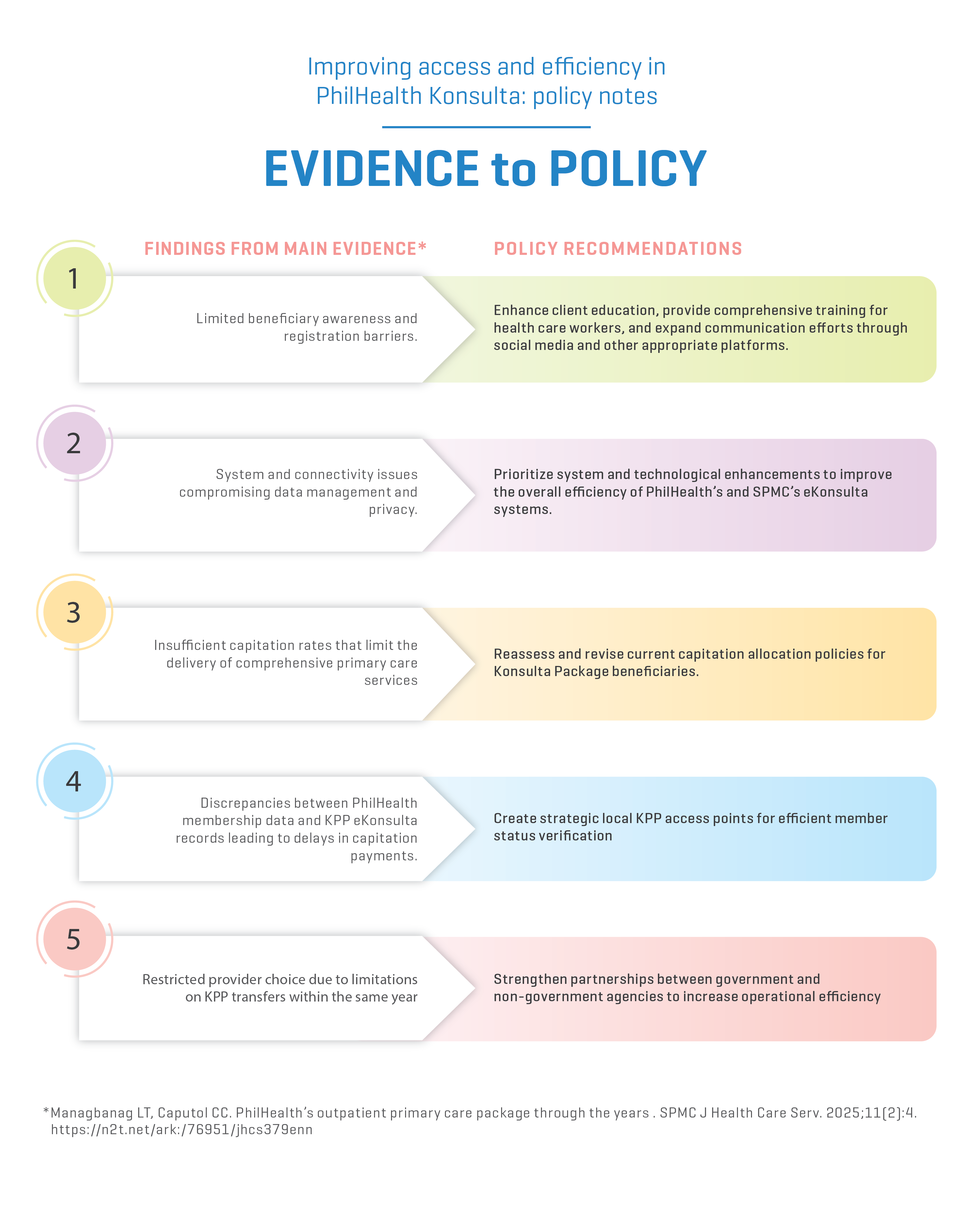
The article of Managbanag, et al. in 2025 highlighted challenges in the implementation of PhilHealth Konsulta at SPMC.6 Despite substantial progress in implementing PhilHealth Konstulta at SPMC, several challenges continue to limit effective enrollment and service delivery. Low awareness of the registration process and beneficiaries’ prior enrollment with other KPPs hinder providers’ ability to secure First Patient Encounters (FPEs) and enroll eligible members. Systemic and digital issues—such as outdated or unverified dependent information requiring intervention from the central PhilHealth office—further increase inconvenience for patients and administrative burden for providers. Connectivity problems within PhilHealth and KPP eKonsulta systems raise concerns about data reliability and security, as these issues impair the downloading of registration masterlists, delay data submission, and heighten risks related to the handling of sensitive patient information. In addition, insufficient capitation rates limit service coverage by failing to reflect the true cost of comprehensive care, compelling patients to seek alternative financing for essential diagnostics and medicines. Claims processing is also affected by inconsistencies between PhilHealth membership records and KPP eKonsulta data, resulting in delayed or denied capitation payments. Finally, limited provider choice remains a concern, as members enrolled with another KPP are unable to transfer to the SPMC KPP within the same year, restricting access to providers that may better meet their health care needs.
Based on the findings, the corresponding policy recommendations are summarized in the evidence-to-policy diagram below.
Based on the findings, the corresponding policy recommendations are summarized in the evidence-to-policy diagram below.
Evidence-to-policy diagram
|
Related evidence
An effective outpatient primary care system seeks to improve population health outcomes by providing accessible, affordable, high-quality, and comprehensive health care services, with a strong emphasis on preventive and promotive care to reduce disease burden and health care costs. Therefore, PhilHealth must ensure the proper implementation of the Konsulta program, now the PhilHealth Yaman ng Kalusugan Program (YAKAP), to guarantee the effective delivery of primary health care services.
The majority of beneficiaries reported limited awareness of the Konsulta Package, with many learning about it for the first time.7 8 To improve awareness and utilization, marketing and communication strategies should align with members’ preferences and information-seeking behaviors, including dissemination through social media, television advertisements, and posters in hospitals and clinics.9 Other avenues for promotion include mobile health initiatives and caravans, community events, and partnerships with national and local agencies such as the Department of Education and the Philippine Information Agency.10 11 Strengthening the use of effective communication channels and targeted messaging is essential for successful program promotion. Additionally, PhilHealth should provide sustained technical support and allocate adequate budgetary resources to ensure effective implementation of the program.9
Connectivity issues in PhilHealth’s and SPMC’s eKonsulta systems hinder reliable data submission and retrieval.12 Strengthening information systems is therefore critical to maintaining an accurate membership database. PhilHealth should implement efficient, well-integrated data management systems supported by strict data governance policies, including routine validation and quality checks, to ensure the integrity and reliability of member information. Additionally, PhilHealth should enhance collaboration with partner agencies by coordinating with the Department of Social Welfare and Development to verify survey data through supporting documents, and partnering with the Philippine Statistics Authority for data sharing to further improve data accuracy and completeness.13
Low capitation rates under the initial PhilHealth Konsulta limited access to essential services and increased reliance on other government health financing schemes and out-of-pocket payments.8 14 To address this, capitation rates have been raised from P500–P750 to P1,700 for both government and private providers,3 and coverage for medicines under the YAKAP program now reaches up to P20,000 annually.15 16 Ongoing monitoring and evaluation are needed to ensure rates remain sufficient and responsive to changes in healthcare costs and service needs.
Discrepancies between PhilHealth records and KPP eKonsulta data, along with delays in patient masterlist generation due to system errors, can hinder timely capitation payments to KPPs.12 17 Addressing this problem by establishing strategic KPP access points through local government units would enable healthcare providers to quickly confirm eligibility, enrollment, and coverage details, reducing delays in service delivery and claims processing. By decentralizing access to membership information, these points can improve operational efficiency, minimize administrative burden on providers, and enhance patient experience by ensuring timely and accurate service provision.18
At SPMC, beneficiaries face restricted provider choice, as transfers from other KPPs within the same year are not allowed, even when their current provider does not meet their needs. Currently, PhilHealth policy generally restricts beneficiaries from transferring to a different KPP (now YAKAP provider) to the fourth quarter of the year (October 1 to December 31), effective the following January.19 20 Nevertheless, PhilHealth should allow beneficiaries to transfer to a different KPP within the same year under specific conditions, such as dissatisfaction with service quality or lack of necessary services.21 Additionally, procedures for inter-KPP transfers should be standardized to ensure transparency, fairness, and equity.
Since its launch, PhilHealth’s YAKAP has driven key improvements aimed at expanding access to primary and preventive health care. Proper implementation of this program can further enhance access by decentralizing services and ensuring the availability of essential care. The program emphasizes prevention and early detection, reducing the need for hospitalization, while improving financial protection by minimizing out-of-pocket costs. Additionally, YAKAP strengthens the healthcare system by reinforcing primary care networks and fostering a system that is more responsive to evolving health needs.
The majority of beneficiaries reported limited awareness of the Konsulta Package, with many learning about it for the first time.7 8 To improve awareness and utilization, marketing and communication strategies should align with members’ preferences and information-seeking behaviors, including dissemination through social media, television advertisements, and posters in hospitals and clinics.9 Other avenues for promotion include mobile health initiatives and caravans, community events, and partnerships with national and local agencies such as the Department of Education and the Philippine Information Agency.10 11 Strengthening the use of effective communication channels and targeted messaging is essential for successful program promotion. Additionally, PhilHealth should provide sustained technical support and allocate adequate budgetary resources to ensure effective implementation of the program.9
Connectivity issues in PhilHealth’s and SPMC’s eKonsulta systems hinder reliable data submission and retrieval.12 Strengthening information systems is therefore critical to maintaining an accurate membership database. PhilHealth should implement efficient, well-integrated data management systems supported by strict data governance policies, including routine validation and quality checks, to ensure the integrity and reliability of member information. Additionally, PhilHealth should enhance collaboration with partner agencies by coordinating with the Department of Social Welfare and Development to verify survey data through supporting documents, and partnering with the Philippine Statistics Authority for data sharing to further improve data accuracy and completeness.13
Low capitation rates under the initial PhilHealth Konsulta limited access to essential services and increased reliance on other government health financing schemes and out-of-pocket payments.8 14 To address this, capitation rates have been raised from P500–P750 to P1,700 for both government and private providers,3 and coverage for medicines under the YAKAP program now reaches up to P20,000 annually.15 16 Ongoing monitoring and evaluation are needed to ensure rates remain sufficient and responsive to changes in healthcare costs and service needs.
Discrepancies between PhilHealth records and KPP eKonsulta data, along with delays in patient masterlist generation due to system errors, can hinder timely capitation payments to KPPs.12 17 Addressing this problem by establishing strategic KPP access points through local government units would enable healthcare providers to quickly confirm eligibility, enrollment, and coverage details, reducing delays in service delivery and claims processing. By decentralizing access to membership information, these points can improve operational efficiency, minimize administrative burden on providers, and enhance patient experience by ensuring timely and accurate service provision.18
At SPMC, beneficiaries face restricted provider choice, as transfers from other KPPs within the same year are not allowed, even when their current provider does not meet their needs. Currently, PhilHealth policy generally restricts beneficiaries from transferring to a different KPP (now YAKAP provider) to the fourth quarter of the year (October 1 to December 31), effective the following January.19 20 Nevertheless, PhilHealth should allow beneficiaries to transfer to a different KPP within the same year under specific conditions, such as dissatisfaction with service quality or lack of necessary services.21 Additionally, procedures for inter-KPP transfers should be standardized to ensure transparency, fairness, and equity.
Since its launch, PhilHealth’s YAKAP has driven key improvements aimed at expanding access to primary and preventive health care. Proper implementation of this program can further enhance access by decentralizing services and ensuring the availability of essential care. The program emphasizes prevention and early detection, reducing the need for hospitalization, while improving financial protection by minimizing out-of-pocket costs. Additionally, YAKAP strengthens the healthcare system by reinforcing primary care networks and fostering a system that is more responsive to evolving health needs.
Contributors
CMPA, and RCR contributed to the conceptualization of this article. CMPA, and RCR wrote the original draft. Both authors performed the subsequent revisions, approved the final version, and agreed to be accountable for all aspects of this article and its corresponding infographic.
Article source
Commissioned
Peer review
Internal
Competing interests
None declared
Access and license
This is an Open Access article licensed under the Creative Commons Attribution-NonCommercial 4.0 International License, which allows others to share and adapt the work, provided that derivative works bear appropriate citation to this original work and are not used for commercial purposes. To view a copy of this license, visit https://creativecommons.org/licenses/by-nc/4.0/.
References
1 Supreme Court of the Philippines. An act instituting Universal Health Care for all Filipinos, prescribing reforms in the health care system, and appropriating funds therefor, Republic Act No. 11223, 2019 Feb 20.
2 Philippine Health Insurance Corporation. Implementing Guidelines for the PhilHealth Konsultasyong Sulit at Tama (PhilHealth Konsulta) Package, PHILHEALTH Circular No. 2020-0022. 2020 Dec 18.
3 Philippine Health Insurance Corporation. Enhancement of the PhilHealth Konsulta Benefit Package, PHILHEALTH Circular No. 2024-0013. 2024 May 14.
4 Philippine Health Insurance Corporation. Capacity-Building Program on Implementation Research for Technical Staff in PhilHealth Regional Offices: Local Evidence to Advanced Decisions (LEAD) – Policy Brief. 2022. Available from: https://www.philhealth.gov.ph/about_us/studies/policybrief/13.
PolicyBrief_TheChallengesInTheServiceProvisionOfPhilHealth.pdf.
5 Philippine Health Insurance Corporation. Governing Policies of the Konsulta+, PHILHEALTH Circular No. 2022-0032. 2022 Dec 28.
6 Managbanag LT, Caputol CC. PhilHealth’s outpatient primary care package through the years . SPMC J Health Care Serv. 2025;11(2):4. https://n2t.net/ark:/76951/jhcs379enn.
7 Cabalza D. PhilHealth: Few Filipinos availing themselves of Konsulta. 2025 Mar 31 [cited 2025 Dec 16]. In: Inquirer.net [Internet]. Makati: Philippine Daily Inquirer. c1997-2025. Available from: https://newsinfo.inquirer.net/2048393/philhealth-few-filipinos-availing-themselves-of-konsulta.
8 Monteagudo GS, Anuran Go, Espina AR. Awareness, perceptions and attitudes regarding PhilHealth Konsulta Outpatient Benefit Package: A cross-sectional study. The Filipino Family Physician. 2025;63(1):57-62.
9 Buemio M, Malla OC, Reyes MRD, Santillan MC, Tuazon FB Jr. POLICY BRIEF - Assessment of PhilHealth’s Marketing Collateral: Drivers and Barriers on the Utilization of Primary Care Benefits. Philippine Health Insurance Corporation. Available from: https://www.philhealth.gov.ph/about_us/studies/policybrief/6.
PhilHealthsMarketingCollateralOnPrimaryCare.pdf.
10 Zamboanga State College of Marine Sciences and Technology. PhilHealth Konsulta Caravan Program at ZSCMST. 2025 May 28 [cited 2025 Dec 28] Available from: https://zscmst.edu.ph/?p=5127.
11 Philippine Health Insurance Corporation. PhilHealth and DepEd forge partnership to ensure health coverage for all learners. 2025 May 13 [cited 2025 Dec 28]. Available from:
https://www.philhealth.gov.ph/news/up/article/2025/
news_6822e8da6d223.php#:~:text=Under%20the%20agreement%2C
%20DepEd%20will,to%20access%20primary%20care%20services.
12 Philippine Health Insurance Corporation. Konsulta Intermittent Concerns, Philippine Health Insurance Corporation Advisory No. 2024-0055. 2024 Nov 13.
13 Bajo RAS, Decena LM, Gella EO, Gonzalez MIR, Hupida N, Mangondato A, et al. Qualitative Study of Factors Affecting the Accuracy of the Primary Data Fields in the Indigent Membership Database. Philippine Health Insurance Corporation. Available from: https://www.philhealth.gov.ph/about_us/studies/policybrief/10.
LEADPolicyBrief-Group3.pdf.
14 Espallardo NL, Sy E, Francisco AA, Laceda J, Dayrit LP, Cruz MVCP, et al. Primary Care Services in the UHC: Cost Identification Study. The Filipino Family Physician. 2022 Dec;60(2):260-267.
15 Philippine Health Insurance Corporation. PhilHealth YAKAP: Yaman ng Kalusugan Program. Available from: https://www.philhealth.gov.ph/yakap/.
16 Philippine Health Insurance Corporation. Selection and Empanelment for Philhealth’s Primary Care Benefit Package, PHILHEALTH Circular No. 2025-0017. 2025 Oct 17.
17 Rappler.com. Data errors seen in 1.3M seniors in PhilHealth list while 4,000 dead still on active list – COA [Internet]. Pasig: Rappler Inc. 2024 Dec 16 - [cited 2025 Dec 16]. Available from: https://www.rappler.com/philippines/data-errors-seniors-philhealth-dead-members-active-list-coa/.
18 One Top Medical System Resources. Unlocking the Full Potential of PhilHealth Konsulta: How Portable Tele-Diagnostics Like IDIS2GO Expand Access and Revenue for Local Governments. Quezon: One Top Medical System Resources. c2025 [cited 2025 Dec 28]. Available from: https://onetopresources.com/unlocking-the-full-potential-of-philhealth-konsulta-thru-telemed/.
19 Philippine Health Insurance Corporation. Transfer of Konsulta Package Provider (KPP), PHILHEALTH Advisory No. 2025-058. 2024 Nov 25.
20 Philippine Health Insurance Corporation. YAKAP Clinic Transfer Guidelines, PHILHEALTH Advisory No. 2025-065. 2025 Dec 2.
21 Australian Government – Department of Health, Disability and Aging. Changing Support at Home providers. Updated 2025 Oct 31 [cited 2025 Dec 28]. Available from:
https://www.health.gov.au/our-work/support-at-home/managing-
support-at-home-services/changing-support-at-home-providers
#:~:text=The%20participant%20should%20tell%20their%20current
%20provider,contributions%20*%20Issue%20a%20final%20monthly
%20statement.
Copyright © 2025 CM Astudillo, et al.
Published
December 28, 2025
Issue
Volume 11 Issue 2 (2025)
Section
Policy notes

This work is licensed under a Creative Commons Attribution-NonCommercial 4.0 International License.
Authors who publish with this journal agree to the following terms:
- Authors retain copyright and grant the journal right of first publication with the work simultaneously licensed under a Creative Commons Attribution-NonCommercial 4.0 International License that allows others to share the work for non-commercial purposes with an acknowledgement of the work's authorship and initial publication in this journal.
- Authors are able to enter into separate, additional, non-commercial contractual arrangements for the non-exclusive distribution of the journal's published version of the work (e.g., post it to an institutional repository or publish it in a book), with an acknowledgement of its initial publication in this journal.
- Authors grant the journal permission to rewrite, edit, modify, store and/or publish the submission in any medium or format a version or abstract forming part thereof, all associated supplemental materials, and subsequent errata, if necessary, in a publicly available publication or database.
- Authors warrant that the submission is original with the authors and does not infringe or transfer any copyright or violate any other right of any third parties.