Before the Trauma and Critical Care Division was established at the Southern Philippines Medical Center (SPMC) in 2022, the hospital lacked a structured Surgical Intensive Care Unit (SICU) system, and patient management varied widely depending on the individual practices of each specialty service. Admission and monitoring, particularly for postoperative cases, were primarily at the discretion of the attending surgeon.
The Surgery Department included several services: General Surgery (GS) 1 (head and neck, reconstruction, soft tissue, and burns), GS 2 (hepatobiliary, pancreas, and pediatric surgery), GS 3 (colorectal and hernia), Thoracic and Cardiovascular Surgery (TCVS), Neurosurgery, and Trauma. However, the absence of unified guidelines posed significant challenges, especially with regard to the management of critically ill patients in the SICU. For example, mechanical ventilator management was under the Pulmonary Service but lacked 24/7 availability due to staffing limitations.
There was also no continuous physician coverage, leaving nurses to monitor patients and refer concerns to attending physicians, who were not always able to respond promptly or initiate timely interventions. Furthermore, orders from different attending physicians were carried out without centralized coordination or oversight, creating gaps in patient care. SICU admission prioritization lacked clear criteria, relying solely on general assessments rather than the specific needs of critically ill patients. Daily patient assessments were inconsistent, further compromising the quality and continuity of care.
Reshaping Surgical Intensive Care Unit services at Southern Philippines Medical Center
SPMC J Health Care Serv. 2025:11(2):2. ARK: https://n2t.net/ark:/76951/jhcs24f3xk
1Institute of Emergency, Trauma and Critical Care, Southern Philippines Medical Center, J.P. Laurel Avenue, Bajada, Davao City
2Research Utilization and Publication Unit, Southern Philippines Medical Center, J.P. Laurel Avenue, Bajada, Davao City
Correspondence Rene A Ogatis, ReneOgatis@gmail.com
Received 4 February 2025
Accepted 2 October 2025
Cite as Ogatis RA, Valdez BEP, Ladrero CXD. Reshaping Surgical Intensive Care Unit services at Southern Philippines Medical Center. SPMC J Health Care Serv. 2025;11(2):2. https://n2t.net/ark:/76951/jhcs24f3xk
SPMC SICU Services before 2022
The Trauma and Critical Care Division at SPMC
The Trauma and Critical Care Division at SPMC was established in 2022, following the creation of the Trauma Division and the adoption of the Philippine Society for the Surgery of Trauma fellowship training curriculum in trauma and surgical care. Its primary goal is to decrease mortality among patients of the Surgery Department by setting clear standards for admission, discharge, and operations in the SICU, aligned with global best practices.
To ensure sustainability, the division also emphasizes continuous training and capacity building, not only within SPMC but across Mindanao. The fellowship training program, as outlined in the official manual, is designed to develop competency in managing critically ill surgical patients.
Fellows are trained to manage complex cases involving sepsis, hemodynamic instability, pulmonary care, endocrine crises, and multi-organ damage. They are expected to apply evidence-based standards and the latest critical care practices to improve patient outcomes. By managing all patients requiring critical care, fellows help strengthen local critical care systems in ways that reflect global health priorities identified by the World Health Organization (WHO) and the WHO Acute Care Network.
To ensure sustainability, the division also emphasizes continuous training and capacity building, not only within SPMC but across Mindanao. The fellowship training program, as outlined in the official manual, is designed to develop competency in managing critically ill surgical patients.
Fellows are trained to manage complex cases involving sepsis, hemodynamic instability, pulmonary care, endocrine crises, and multi-organ damage. They are expected to apply evidence-based standards and the latest critical care practices to improve patient outcomes. By managing all patients requiring critical care, fellows help strengthen local critical care systems in ways that reflect global health priorities identified by the World Health Organization (WHO) and the WHO Acute Care Network.
SICU system reforms
The introduction of the new SICU Admission Guidelines in 20231 marked a turning point in how critically ill surgical patients were managed at SPMC. Before their adoption, the SICU functioned under an open system: primary surgical teams retained responsibility for their patients, with intensivist support largely absent. This arrangement often resulted in fragmented decision-making, delayed interventions, and inconsistent practices such as ventilator management.
With the implementation of the new guidelines in 2024, the SICU shifted to a hybrid model. In this system, critical care intensivists are physically present in the unit and serve as attending physicians, leading comprehensive patient assessment, monitoring, and management—such as hemodynamic support, resuscitation, and ventilation strategies—while also directing protocolized care. Today, critical care surgeons play a pivotal role in optimizing mechanical ventilation, ensuring adherence to lung-protective strategies, and overseeing weaning protocols—tasks that were previously fragmented among anesthesiologists, pulmonologists, or general surgeons. Comanagement with surgical subspecialists remains essential: trauma, cardiothoracic, and neurosurgical teams continue to provide input on operative complications, wound management, and re-interventions, while medical subspecialists such as nephrology, cardiology, and infectious diseases assist with complex comorbidities. Decision-making authority is carefully balanced, as intensivists determine ICU-specific interventions, including when to delay surgery due to instability, whereas surgeons retain operative control over operative timing and technique. Transfers out of the SICU follow standardized criteria, coordinated closely between intensivists and the original surgical teams to ensure continuity of care.
Institutional models further define this spectrum. Closed ICUs, common in academic centers, place full authority with intensivists and reduce variability of care. Open ICUs leave control with primary surgeons, but this often fragments decision-making. Hybrid models combine intensivist oversight with surgical collaboration, typically through multidisciplinary rounds. SPMC currently operates under a hybrid system but is actively transitioning toward a closed SICU to strengthen consistency and outcomes.
This progression has already resolved persistent issues of the open system, including inconsistent ventilator management, delayed interventions, and weak care coordination. By clarifying roles, standardizing workflows, and aligning intensivist leadership with surgical expertise, the SICU now delivers more efficient and team-based care. The next steps focus on fully consolidating the closed model, refining protocols, and expanding innovations such as telecritical care to maximize resources and sustain improved outcomes for critically ill surgical patients.
With the implementation of the new guidelines in 2024, the SICU shifted to a hybrid model. In this system, critical care intensivists are physically present in the unit and serve as attending physicians, leading comprehensive patient assessment, monitoring, and management—such as hemodynamic support, resuscitation, and ventilation strategies—while also directing protocolized care. Today, critical care surgeons play a pivotal role in optimizing mechanical ventilation, ensuring adherence to lung-protective strategies, and overseeing weaning protocols—tasks that were previously fragmented among anesthesiologists, pulmonologists, or general surgeons. Comanagement with surgical subspecialists remains essential: trauma, cardiothoracic, and neurosurgical teams continue to provide input on operative complications, wound management, and re-interventions, while medical subspecialists such as nephrology, cardiology, and infectious diseases assist with complex comorbidities. Decision-making authority is carefully balanced, as intensivists determine ICU-specific interventions, including when to delay surgery due to instability, whereas surgeons retain operative control over operative timing and technique. Transfers out of the SICU follow standardized criteria, coordinated closely between intensivists and the original surgical teams to ensure continuity of care.
Institutional models further define this spectrum. Closed ICUs, common in academic centers, place full authority with intensivists and reduce variability of care. Open ICUs leave control with primary surgeons, but this often fragments decision-making. Hybrid models combine intensivist oversight with surgical collaboration, typically through multidisciplinary rounds. SPMC currently operates under a hybrid system but is actively transitioning toward a closed SICU to strengthen consistency and outcomes.
This progression has already resolved persistent issues of the open system, including inconsistent ventilator management, delayed interventions, and weak care coordination. By clarifying roles, standardizing workflows, and aligning intensivist leadership with surgical expertise, the SICU now delivers more efficient and team-based care. The next steps focus on fully consolidating the closed model, refining protocols, and expanding innovations such as telecritical care to maximize resources and sustain improved outcomes for critically ill surgical patients.
The present SICU system
Following the adoption of stricter triage guidelines and the shift toward nonoperative trauma care, the SICU has seen marked changes in admission patterns. Direct admissions from the emergency department (ED) have increased, reflecting the system’s responsiveness to critically ill trauma patients. The average ICU stay of 8 days highlights the complexity of conditions being treated, as extended stays are often associated with more severe illness or complications. With bed occupancy at 82.6%, the ICU operates near capacity, underscoring the importance of effective patient management to ensure timely bed availability without compromising care quality.
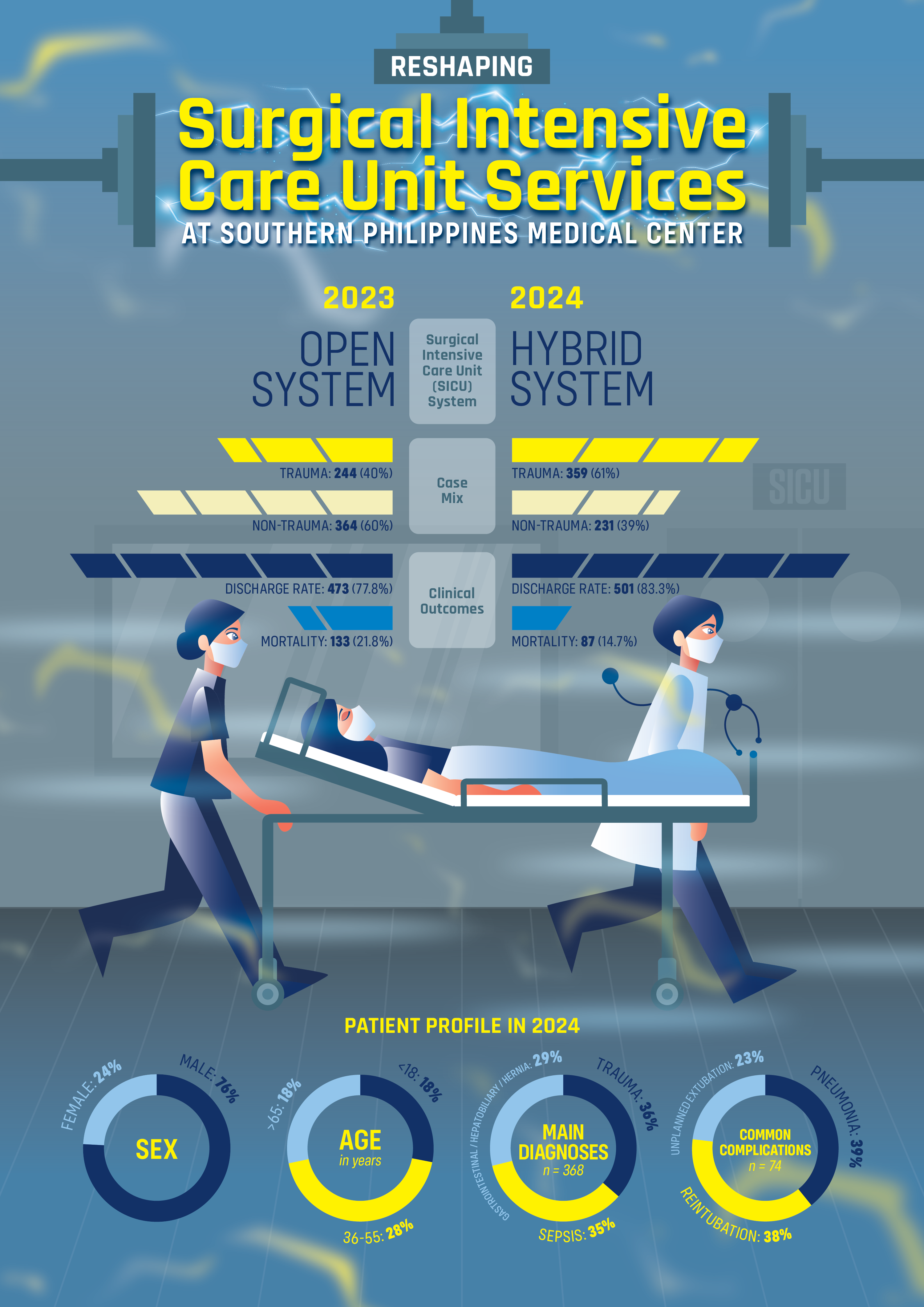
In 2023, trauma accounted for 40% (244 patients) of admissions and non-trauma for 60% (364 patients). By 2024, the case mix had reversed, with trauma increasing to 61% (359 patients) and non-trauma decreasing to 39% (231 patients). This shift coincided with the transition from a traditionally open system—in which the referring surgeons served as the primary physicians for ICU patients—toward a hybrid ICU system that integrates intensivist-led management with ongoing surgical involvement. The current critical care team includes on-call intensivist consultants, 24/7 critical care fellows, and dedicated surgical residents, under a comanagement framework involving both surgical and medical subspecialists. The change in case mix has helped channel care towards more critical cases and established a more consistent critical care-led approach to patient management.
The 2024 transition to a hybrid ICU system with mandatory critical care oversight significantly reshaped referral patterns. Compared to 2023’s open model, total admissions from non-ICU surgical departments and subspecialties decreased by 36.5%, reflecting stricter triage enforcement. General Surgery saw the steepest decline (-48.5%), indicating effective filtering of less critical cases. Monthly referrals stabilized (12 to 31/month), replacing prior volatility (e.g., 39 in February versus 15 in November 2023), with historically high-volume months (January, July, October) showing reductions exceeding 50%. Despite overall decreases, access for more critical patients was preserved: Urology (+30%), ENT (+17%), Neurosurgery (+33%), and new referrals from Obstetrics-Gynecology rose. However, persistently low referrals in late 2024 (e.g., October: 12; November: 14) merit review to avoid under-triaging that could delay care for critically ill surgical patients. Overall, the hybrid ICU model strengthened triage precision and reduced unnecessary admissions, though continued vigilance is needed to safeguard timely access to critical care.
To better contextualize these system-level changes, the following describes the profile of patients admitted to the SICU in 2024. There was a male predominance (76%), underscoring ongoing sex- or gender-related disparities in critical surgical conditions. The age distribution revealed three vulnerable cohorts: working-age adults (36-55 years: 28%), older adults (>65 years: 18%), and pediatric patients (under 18 years: 18%), highlighting the need for age-specific critical care strategies. Diagnoses reflected the complexity of ICU care, with trauma (134 cases), sepsis (128 cases), and gastrointestinal/hepatobiliary/hernia (106 cases) being the most prevalent. Morbidities included hospital-acquired pneumonia (29 cases) and airway complications (reintubation: 28; unplanned extubation: 17), pointing to opportunities for further care optimization. These demographic and clinical characteristics provide the necessary context for interpreting the outcomes observed in 2024.
Clinical outcomes improved markedly in 2024, with the discharge rate rising from 77.8% (473 patients) in 2023 to 83.3% (501 patients). Mortality declined to 14.7% (87 patients), reflecting a 7.1% absolute reduction from the previous year’s rate of 21.8% (133 patients). This improvement occurred despite a rise in the proportion of trauma cases requiring intensive intervention, indicating more efficient utilization and targeted allocation of critical care resources. Mortality rates were comparable between trauma (14.2%) and non-trauma (14.4%) groups, and only 1% of patients left against medical advice. The selective admission strategy—driven by stricter triage protocols—correlated with this mortality reduction, suggesting that resources were concentrated on patients with greater clinical need.
In 2023, trauma accounted for 40% (244 patients) of admissions and non-trauma for 60% (364 patients). By 2024, the case mix had reversed, with trauma increasing to 61% (359 patients) and non-trauma decreasing to 39% (231 patients). This shift coincided with the transition from a traditionally open system—in which the referring surgeons served as the primary physicians for ICU patients—toward a hybrid ICU system that integrates intensivist-led management with ongoing surgical involvement. The current critical care team includes on-call intensivist consultants, 24/7 critical care fellows, and dedicated surgical residents, under a comanagement framework involving both surgical and medical subspecialists. The change in case mix has helped channel care towards more critical cases and established a more consistent critical care-led approach to patient management.
The 2024 transition to a hybrid ICU system with mandatory critical care oversight significantly reshaped referral patterns. Compared to 2023’s open model, total admissions from non-ICU surgical departments and subspecialties decreased by 36.5%, reflecting stricter triage enforcement. General Surgery saw the steepest decline (-48.5%), indicating effective filtering of less critical cases. Monthly referrals stabilized (12 to 31/month), replacing prior volatility (e.g., 39 in February versus 15 in November 2023), with historically high-volume months (January, July, October) showing reductions exceeding 50%. Despite overall decreases, access for more critical patients was preserved: Urology (+30%), ENT (+17%), Neurosurgery (+33%), and new referrals from Obstetrics-Gynecology rose. However, persistently low referrals in late 2024 (e.g., October: 12; November: 14) merit review to avoid under-triaging that could delay care for critically ill surgical patients. Overall, the hybrid ICU model strengthened triage precision and reduced unnecessary admissions, though continued vigilance is needed to safeguard timely access to critical care.
To better contextualize these system-level changes, the following describes the profile of patients admitted to the SICU in 2024. There was a male predominance (76%), underscoring ongoing sex- or gender-related disparities in critical surgical conditions. The age distribution revealed three vulnerable cohorts: working-age adults (36-55 years: 28%), older adults (>65 years: 18%), and pediatric patients (under 18 years: 18%), highlighting the need for age-specific critical care strategies. Diagnoses reflected the complexity of ICU care, with trauma (134 cases), sepsis (128 cases), and gastrointestinal/hepatobiliary/hernia (106 cases) being the most prevalent. Morbidities included hospital-acquired pneumonia (29 cases) and airway complications (reintubation: 28; unplanned extubation: 17), pointing to opportunities for further care optimization. These demographic and clinical characteristics provide the necessary context for interpreting the outcomes observed in 2024.
Clinical outcomes improved markedly in 2024, with the discharge rate rising from 77.8% (473 patients) in 2023 to 83.3% (501 patients). Mortality declined to 14.7% (87 patients), reflecting a 7.1% absolute reduction from the previous year’s rate of 21.8% (133 patients). This improvement occurred despite a rise in the proportion of trauma cases requiring intensive intervention, indicating more efficient utilization and targeted allocation of critical care resources. Mortality rates were comparable between trauma (14.2%) and non-trauma (14.4%) groups, and only 1% of patients left against medical advice. The selective admission strategy—driven by stricter triage protocols—correlated with this mortality reduction, suggesting that resources were concentrated on patients with greater clinical need.
Persistent issues
The SICU achieved a commendable discharge rate of 83.3% in 2024, indicating that most patients recovered sufficiently to leave and reflected positively on care quality. However, the mortality rate of 14.7% (representing 87 patients) highlights areas for improvement, while the 1% who left against medical advice raises concerns about patient satisfaction and support systems. Morbidities such as pneumonia and reintubation underscore challenges in maintaining optimal care, especially with respect to preventing hospital-acquired infections during prolonged ICU stays. These trends warrant a review of clinical processes, staff training, and monitoring practices.
What the present SICU has achieved
Reforms by the Trauma and Critical Care Division have reshaped SICU services at SPMC, correcting long-standing gaps in admission practices, patient care, and interdisciplinary coordination. Stricter triage and gatekeeping reduced unnecessary referrals, streamlined admissions, and ensured resources were directed to the most critically ill. Coordination with the OR, ED, and surgical services improved, minimizing delays and bureaucratic hurdles.
Clinical outcomes strengthened: discharge rates rose, mortality declined, and survival was comparable between trauma and non-trauma patients—evidence of consistent care quality. The hybrid ICU system reinforced intensivist leadership while preserving surgical input, standardizing protocols, and improving ventilation management. Although morbidities such as hospital-acquired pneumonia and airway complications persist, they reflect the inherent challenges of critical care rather than declining standards.
The case mix shifted toward higher-acuity trauma patients, underscoring SICU’s evolving role as a specialized, resource-focused unit. Staff training also improved, with fellows and residents gaining structured exposure to evidence-based critical care.
All in all, the present SICU has become a more efficient, standardized, and collaborative system of care, aligning patient needs with resources while strengthening institutional capacity. Sustaining progress will require continued protocol refinement, consolidation of the closed model, and ongoing cultural change to secure durable gains in surgical critical care delivery.
Clinical outcomes strengthened: discharge rates rose, mortality declined, and survival was comparable between trauma and non-trauma patients—evidence of consistent care quality. The hybrid ICU system reinforced intensivist leadership while preserving surgical input, standardizing protocols, and improving ventilation management. Although morbidities such as hospital-acquired pneumonia and airway complications persist, they reflect the inherent challenges of critical care rather than declining standards.
The case mix shifted toward higher-acuity trauma patients, underscoring SICU’s evolving role as a specialized, resource-focused unit. Staff training also improved, with fellows and residents gaining structured exposure to evidence-based critical care.
All in all, the present SICU has become a more efficient, standardized, and collaborative system of care, aligning patient needs with resources while strengthening institutional capacity. Sustaining progress will require continued protocol refinement, consolidation of the closed model, and ongoing cultural change to secure durable gains in surgical critical care delivery.
Contributors
RAO and BEPV conceptualized the article. RAO, and BEPV wrote the original draft, while CXDL rendered the original draft of the infographic. All authors performed the subsequent revisions, approved the final version, and agreed to be accountable for all aspects of this article and its corresponding infographic.
Article source
Commissioned
Peer review
External
Competing interests
None declared
Access and license
This is an Open Access article licensed under the Creative Commons Attribution-NonCommercial 4.0 International License, which allows others to share and adapt the work, provided that derivative works bear appropriate citation to this original work and are not used for commercial purposes. To view a copy of this license, visit https://creativecommons.org/licenses/by-nc/4.0/.
References
1 Salvador KGR, Valdez BEP, Ladrero CXDL. Implementation of trauma protocols in Southern Philippines Medical Center in 2024. SPMC J Health Care Serv. 2024;10(2):2. https://n2t.net/ark:/76951/jhcs56hd6r.
Copyright © 2025 RA Ogatis, et al.
Published
October 10, 2025
Issue
Volume 11 Issue 2 (2025)
Section
Health care focus

This work is licensed under a Creative Commons Attribution-NonCommercial 4.0 International License.
Authors who publish with this journal agree to the following terms:
- Authors retain copyright and grant the journal right of first publication with the work simultaneously licensed under a Creative Commons Attribution-NonCommercial 4.0 International License that allows others to share the work for non-commercial purposes with an acknowledgement of the work's authorship and initial publication in this journal.
- Authors are able to enter into separate, additional, non-commercial contractual arrangements for the non-exclusive distribution of the journal's published version of the work (e.g., post it to an institutional repository or publish it in a book), with an acknowledgement of its initial publication in this journal.
- Authors grant the journal permission to rewrite, edit, modify, store and/or publish the submission in any medium or format a version or abstract forming part thereof, all associated supplemental materials, and subsequent errata, if necessary, in a publicly available publication or database.
- Authors warrant that the submission is original with the authors and does not infringe or transfer any copyright or violate any other right of any third parties.